

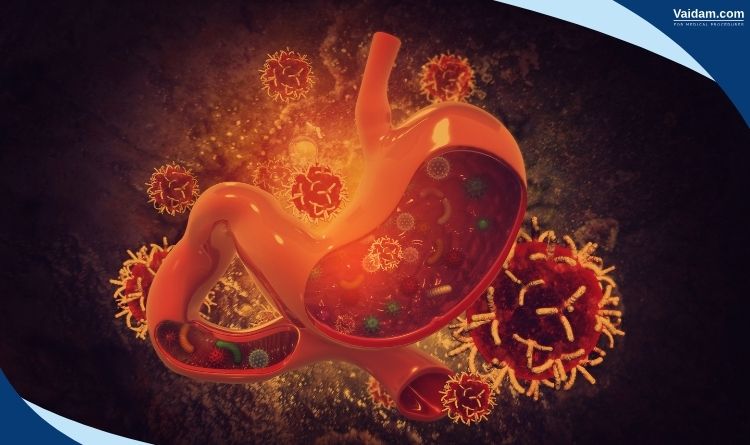
Stomach cancer has come up as one of the most pressing global health issues diagnosed in the recent past. Also called gastric cancer, in 2020, it affected more than one million across the globe, and it is mostly among those above the age of 65.
With recent advancements, cancer treatment has reached new heights, and many countries such as the USA, UK, Germany, China etc. are trying to provide a precise diagnosis and treatment at affordable cost.
Why Choose India for Stomach Cancer Treatment?
Currently, India has turned out to be one of the treatment places for stomach cancer with advanced infrastructures in medicine, highly skilled oncologists, and healthcare solutions offered at relatively low cost.
Here’s why you should opt for India for the cure of stomach cancer:
-
Advanced Cancer Therapies
India has made these advanced therapies more easily accessible and has helped treat cancers with minimal side effects. Many Cancer hospitals in India participate in clinical trials which give patients access to precise treatments that may not be widely available.
-
Cost-effective Care
The cost of treatment in India is significantly more affordable as compared to the West while not cutting on the quality. The best cancer hospitals in India have well-rounded treatment packages, which include surgery, chemotherapy, and post-surgical care at a fraction of the cost.
-
Focus on Early Diagnosis
Through advanced diagnostic technologies and accessible screenings, diagnosis and treatment of stomach cancer in India have become more effective, affordable, and patient-centred, with better results. Many research studies have indicated that stomach cancer can be more easily treated, and patients will survive if detected at its early stages. This is because it can be treated using fewer invasive methods, thereby lowering the complications and improving quality of life.
Stomach Cancer: Key Facts
- Stomach cancer accounts for about 6% of all cancer cases worldwide.
- The main risk factor is Helicobacter pylori infection. This bacterium infection is felt to contribute to gastric ulcers and contributes towards an increased risk of developing stomach cancer with time.
What is Stomach Cancer and its Symptoms?
Stomach, or gastric cancer, occurs when healthy cells in the stomach undergo abnormal growth, leading to the formation of a tumour. This tumour can either be benign, meaning it grows in size but doesn’t spread to other parts of the body, or malignant, meaning it grows and spreads to other areas.
Stomach cancer can originate in any part of the stomach and may metastasise to organs such as the liver, lungs, bones, ovaries, or abdominal cavity.
Some of the common symptoms of stomach cancer are:
- Persistent indigestion
- Bloating after meals
- Sudden and unexplained disinterest in food
- Unintentional weight loss
- Fatigue
- Stomach pain
- Difficulty swallowing
- Nausea and vomiting, which may include blood in advanced stages
Stages of Stomach Cancer
Stomach cancer is categorised into stages based on the tumour’s size and spread:
- Stage 0: The cancer is localised and has not spread beyond the inner lining of the stomach.
- Stage I: Cancer has spread to the submucosa or muscle layer of the stomach but not beyond that layer.
- Stage II: Cancer has now spread to lymph nodes or deeper into the stomach walls.
- Stage III: Cancer has spread to more distant organs, including nearby lymph nodes or the outer lining of the stomach.
- Stage IV: Cancer has spread to distant organs, such as the liver, lungs, or distant lymph nodes.
The most common type of stomach cancer is adenocarcinoma, which begins in the glandular tissue. Other forms include primary gastric lymphoma (PGL), neuroendocrine tumours, and gastric sarcoma.
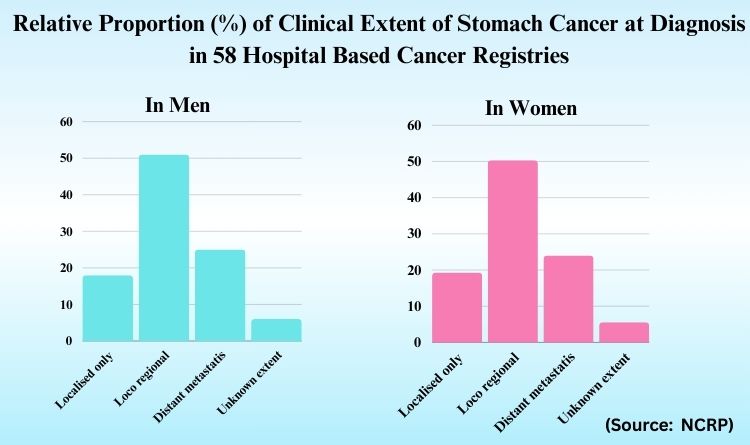
What are the Risk Factors associated with the Stomach Cancer Treatment?
Researchers have established several risk factors for stomach cancer. Some factors that are risk-related, such as smoking, can be controlled, while others, for example, age or family history, cannot be controlled.
Here’s some general information about typical factors which raise the chance of stomach cancer:
- Age
The risk of stomach cancer increases with age and is most common between 60 and 70 years.
- Gender
Males are more at risk for developing stomach cancer than females.
- Geography
The risk of stomach cancer is higher in East Asia, South America, Central America and Eastern Europe than in Africa and North America.
- Alcohol and Smoking
Three or more alcoholic beverages consumed daily greatly increase the risk of stomach cancer. Tobacco use raises the risk nearly twofold, especially for upper types of stomach cancer.
- Family History
Having a first-degree relative, such as a parent, sibling, or child who suffers from stomach cancer doubles or triples the risk. In case several close relatives are affected, the risk could be as much as 10-fold.
- Helicobacter pylori Infection
Long-term infection with the H. pylori bacteria can cause chronic inflammation and atrophic gastritis, which may lead to precancerous changes in the stomach lining.
- Epstein-Barr Virus (EBV) Infection
Around 5–10% of stomach cancers are linked to the Epstein-Barr virus. These cancers grow slowly and have less chances to spread to other parts of the body.
Treatment Options for Stomach Cancer
The treatment of stomach cancer in India depends on three important factors:
- Stage of cancer: The treatment options depend on whether the cancer is localised in one area or at an advanced metastatic stage where the tumour has spread to nearby tissues.
- Tumour biology: The characteristics of the tumour, such as HER2 status (a specific protein that can affect cancer growth) and any genetic mutations, influence the choice of treatment. These biological markers help doctors determine the most effective therapies for the patient’s needs.
- Overall health: A patient’s general health plays a crucial role in determining the treatment approach. Some treatments may not be safe for patients who have other health issues.
Stomach Cancer Surgery
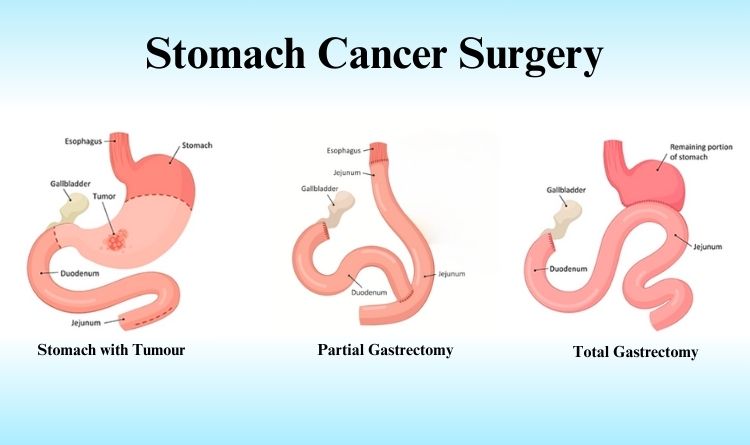
Surgery is often the first-line treatment for stomach cancer, especially when it has been detected early. The approach to surgery depends on how far the cancer has spread.
- Partial Gastrectomy: If the tumour is limited to a part of the stomach, only the affected part is removed. The rest of the stomach continues to function normally.
- Total Gastrectomy: For more advanced cancers, the entire stomach might need to be removed. Then, your digestive system is reconstructed to allow food to pass directly into your small intestine.
- Endoscopic Resection: This minimally invasive option is used for very early-stage cancers. A thin, flexible tube is inserted into your stomach to remove the tumour without major surgery.
Surgery offers the best chance of cure if the cancer hasn’t spread beyond the stomach.
Chemotherapy
Chemotherapy for stomach cancer in India uses drugs which attack cancer cells throughout the body. Depending on your diagnosis, it can be used:
- Neoadjuvant Chemotherapy: In this approach, chemotherapy is employed to shrink the tumour prior to surgery, making it easier to remove with minimal incisions and complications.
- Adjuvant Chemotherapy: Once the surgery is over, chemotherapy is done to destroy any cancer cells that have been left behind. It reduces the risk of recurrence.
- When surgery isn’t possible, chemotherapy helps control the disease and alleviate symptoms.
Chemotherapy, however, can cause side effects like fatigue, nausea, or hair loss, but newer treatments aim to minimise these complications.
Radiation Therapy
Radiation therapy for stomach cancer in India targets and kills cancer cells using high-energy beams. Similar to chemotherapy, it is used:
- Before surgery- to reduce tumour size.
- After surgery- to eliminate remaining cancer cells.
- To relieve symptoms like pain or bleeding in advanced cases.
Radiation is highly precise, which helps protect healthy tissues while focusing on the cancer.
Targeted Therapy
Unlike chemotherapy, targeted therapy focuses on specific features of cancer cells. For example:
- HER2-Positive Cancer: If your tumour has the HER2 protein, drugs like trastuzumab (Herceptin) can block its growth.
- Angiogenesis Inhibitors: These drugs, such as ramucirumab, cut off the blood supply that tumours need to grow.
This approach is less likely to harm normal cells as blood vessels for cancer cells are inhibited, meaning fewer side effects for you.
Monoclonal antibodies (mAbs) are a type of targeted therapy that specifically binds to proteins or receptors found on cancer cells or their surrounding environment. An increasing number of innovative mAb therapeutics are available in the global market, with biosimilar versions now also approved, including in India.
In stomach cancer, these therapies are designed to block key pathways that promote tumour growth and survival.
Here’s an explanation of the examples of mAbs for Stomach Cancer Treatment mentioned:
Table: Monoclonal Antibodies for Stomach Cancer Treatment
|
Drug |
Target |
Mechanism |
Use |
|---|---|---|---|
|
Ramucirumab (Cyramza®) |
VEGF/VEGFR2 pathway |
- Blocks VEGFR2, the receptor for VEGF, which stimulates blood vessel formation (angiogenesis). - Cuts off the tumour’s blood supply by preventing new blood vessel growth. |
- Used in advanced or metastatic stomach cancer. - Can be used alone or with chemotherapy. |
|
Trastuzumab (Herceptin®) |
HER2 pathway |
- Binds to HER2 receptors on cancer cells. - Blocks signals that promote cell growth and division. - Marks cancer cells for destruction by the immune system. |
- Used with chemotherapy for HER2-positive advanced or metastatic stomach cancer. |
|
Trastuzumab Deruxtecan (Enhertu®) |
HER2 pathway |
- Combines trastuzumab with a chemotherapy agent (antibody-drug conjugate). - Targets HER2 receptors, delivering chemotherapy directly into cancer cells while sparing healthy cells. |
- Effective for HER2-positive stomach cancer that has progressed after trastuzumab-based therapy. |
Immunotherapy
Cancer cells often hide from the immune system by exploiting immune “checkpoints,” such as PD-1/PD-L1 pathways. Immune checkpoint inhibitors block these pathways, enabling immune cells to attack cancer.
A key drug approved for advanced or metastatic stomach cancer is Pembrolizumab (Keytruda®). It targets the PD-1 receptor and is, particularly, in patients with high Programmed Cell Death Protein 1 or MSI-H (Microsatellite Instability-High) tumours.
The five-year overall survival for stomach cancer is about 30-32%. But again, if you break it down by stage, you know, for the early stage which is localised is about 70%. If you look at the locally advanced stage, it is about 32%, and then for distant metastatic disease, it is 6%.
Dr. Lionel Kankeu Fonkoua, a Mayo Clinic medical oncologist
Costs of Different Types of Stomach Cancer Treatment in India
Stomach Cancer Treatment cost in India ranges between INR 4,00,00 and INR 5,00,000 ($7000 and $8000).
- The cost of partial gastrectomy in India ranges from INR 4,50,000 to 5,00,000 in open surgery approach ($8000 to $8800). In case of robotic approach, the cost rises to INR 7,00,000 ($12,500)
- The cost of total gastrectomy in India ranges from INR 550000 to INR 6,00,000 ($9500 to $10,500). In case of robotic surgery, INR 7,50,000 ($13,000).
- The cost of chemotherapy in India ranges between INR 70,000 and INR 1,50,000 ($ 1500 and $ 2800).
- The cost of immunotherapy in India ranges between INR 1,45,000 and INR 3,50,000 ($ 2500 and $ 7000).
- The cost of radiation therapy in India ranges between INR 2,50,000 and INR 3,50,000 ($ 5000 and $ 6500)
Best Doctors For Stomach Cancer Treatment In India
If you are looking for the best stomach cancer doctors in India, here is a list for you.
With over 40 years of experience, Dr. Ashok Vaid specialises in treating organ-specific cancers, including stomach and thyroid cancers. He holds the distinction of successfully completing the first 25 bone marrow transplants in the private healthcare sector of North India.
With over 50 years of practice, he is among the most seasoned oncologists in India. He specialises in managing and treating malignancies of the prostate, colorectal, stomach, cervical, and other organs. The Indian government awarded him the Padma Bhushan Award in 2012 and the Padma Shri in 2002.
With over 36 years of experience, Dr. Jalaj Baxi is amongst the best surgical oncologists in India. He specialises in performing surgeries for gastrointestinal cancer and colorectal cancer surgery with laparoscopic and minimally invasive surgery.
He is a well-known Surgical Oncologist in Chennai. He has more than 19 years of experience in treating gastrointestinal and urological cancers, as well as soft tissue cancers.
He has more than 50 years of experience and is one of India’s leading Medical Oncologists in India. He specialises in the management of gastrointestinal, urological, and gynaecological cancers, plus lymphomas and myelomas.
Best Hospitals for Stomach Cancer Treatment in India
India has numerous excellent top hospitals renowned for the comprehensive care offered, including quality diagnostic facilities and advanced surgical techniques, chemotherapy, radiotherapy, and palliative care.
Choose a hospital that specialises in stomach cancer treatment. You can check the list of the best stomach cancer treatment hospitals in India below.
Established in 2001, this hospital offers advanced Centres of Excellence in Robotic Surgery and Oncology (Medical, Surgical and Radiation).
Max Super Speciality Hospital, Saket, New Delhi
Established in 2005, this hospital has gained fame for cancer treatment that covers surgical and chemotherapy treatments. A multidisciplinary approach provides better results in stomach cancer treatment in India.
Apollo Proton Cancer Centre, Chennai
The hospital was established in 2019 as a centre specialising in proton therapy, which precisely hits the tumour and combines it with chemotherapy for effective treatment
Medanta - The Medicity Hospital, Gurgaon
The hospital was established in 2019, and it focuses on early detection and personalised treatment strategies for gall bladder treatment in India.
The hospital was established in 1999 and is known for its expertise in surgical oncology and advanced treatment options, offering a range of therapies, including targeted and immunotherapy.
Preparing for Stomach Cancer Treatment
Pre-Treatment Tests and Procedures
- First, you’ll meet with an oncologist in India who specialises in gastrointestinal cancers. They will evaluate your medical history, conduct physical examinations, and review any previous diagnostic tests.
- Your doctor will order CT scans, MRIs, PET scans and endoscopy to determine the extent of the cancer (stage) and decide the best course of treatment.
- Blood tests will check your overall health, including liver and kidney function and other vital markers, to evaluate your body’s readiness for surgery and chemotherapy.
A team of specialists (oncologists, surgeons, radiologists, nutritionists) will be involved in your stomach cancer diagnosis and treatment in India, which is common in top cancer treatment centres in India.
During the treatment procedure
If the cancer is detected at an early stage or localised, surgery is often the first option. Gastrectomy involves the removal of part or all of the stomach and is the primary surgical procedure.
- Surgeons may also remove nearby lymph nodes to ensure cancer hasn’t spread.
- This procedure is performed under general anaesthesia, and recovery can take a few weeks.
- The duration of stomach cancer surgery ranges between 6-8 hours.
After the Procedure
Based on the surgery type or treatment, you may be required to adjust your diet and lifestyle. For instance, after a total gastrectomy, you’ll need to adapt to a new way of eating and may require vitamin supplements.
How to Prepare for the Stomach Cancer Treatment in India with Vaidam Health?
Stomach cancer treatment in India requires careful preparation. This includes organising medical records and managing travel arrangements.
You can take the help of the step-by-step guide given below.
Organise Medical Documents
- Collect all relevant diagnostic records, such as biopsy results, endoscopy, CT/MRI scans, and blood test reports.
- Don’t forget to take records of any prior treatments, surgeries, or ongoing health conditions.
- Prepare a detailed list of current medications, along with dosages and frequencies.
Obtain a Referral Letter
Secure a referral letter from your current doctor summarising your diagnosis and the recommended treatment approach.
Check Passport and Visa
- Ensure that the validity of your passport is at least six months from the date you are travelling.
- You can apply for a medical visa with supporting documents, including a hospital invitation letter, provided by your chosen hospital or facilitator, like Vaidam Health.
Confirm Insurance and Budget
- You should verify if your health insurance includes coverage for stomach cancer treatment abroad.
- If uninsured, Vaidam Health can assist in creating affordable treatment packages, including hospital costs, doctor fees, and post-treatment care.
Plan Travel and Accommodation
- With Vaidam Health, book your flights with ease and make your airport pick-up services hassle-free
- We will reserve your accommodations near the hospital for convenience. Vaidam Health can help secure cost-effective lodging.
At Vaidam Health, we partner with top stomach cancer hospitals for supportive care for Stomach Cancer in India. We provide:
- Personalised recommendations for stomach cancer treatment
- Assistance in finding leading cancer specialists
- Comprehensive guidance and custom treatment packages
- Efficient appointment scheduling
- Accommodation and visa assistance
- Translation services for international patients
We are dedicated to offering a stress-free experience for you throughout the procedure and recovery.
Frequently Asked Questions Related to Stomach Cancer Treatment in India
Why should you prefer India for stomach cancer treatment?
India offers affordable treatment for stomach cancer with advanced technology. The skilled doctors here offer personalised care with shorter waiting times.
What is the recovery time of stomach cancer treatment?
The recovery time for stomach cancer treatment is between 3-6 months, depending on treatment type, surgery, etc.
What is the success rate of stomach cancer treatment in India?
The success rate of stomach cancer treatment depends on the cancer stage. As for Stage 0, the success rate is around 70%, which reduces as the cancer reaches the advanced stage.
What is the survival rate of stomach cancer treatment in India?
For developed nations, the 5-year survival is less than 30%. However, in developing countries like India, the 5-year survival is around 20%.
 Chat
Chat