

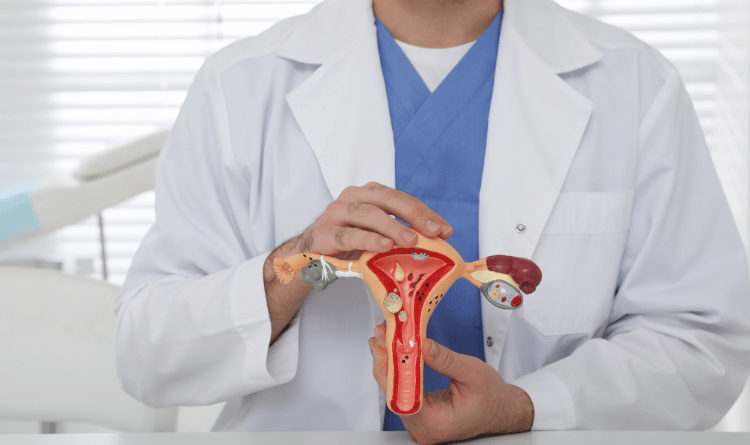
Endometriosis can severely affect any woman. While it is not considered a fatal disease, it is a painful condition that can substantially affect a woman's quality of life and her chances of getting pregnant.
Being the top destination in the world, Thailand is a hub for advanced healthcare services, high-quality medical care, and affordable cost of endometriosis.
Patients with endometriosis can save considerable money on treatment by seeking medical care in Thailand. The estimated cost of treatment in Thailand is 40% or less than the average cost in countries like the UK, the US, France, and Germany. This allows patients to receive top-notch medical care while enjoying significant savings.
The average cost of treatment of endometriosis in Thailand typically ranges from around 730 USD to 1000 USD.
What is Endometriosis?
A woman's uterus is covered in endometrial tissue, the endometrium. With every menstrual cycle, the body develops a fresh endometrium in anticipation of a fertilized egg. Endometriosis is a medical condition where the tissue that lines the uterus grows outside of it.
Women between the ages of 25 and 29 experience a higher incidence of the disease, while those over 44 experience the lowest. Additionally, prevalence rates are higher among white individuals compared to African-Americans.
Did you know endometriosis affects around 10% of women aged 15 to 44? This condition typically manifests in the pelvis or abdomen, particularly on or near reproductive organs including the following:
- Ligaments around the uterus (uterosacral ligaments)
- Fallopian tubes
- The lining of the pelvic cavity
- Ovaries
- The surface outside of the uterus
- The space located between the uterus and the rectum or bladder.
Less commonly, it may also develop on and surrounding the following:
- Bladder
- Intestines
- Cervix
- Vagina or vulva
- Stomach (abdomen)
- Rectum
If the endometrial tissue grows outside the uterus, it will not generally shed during the menstrual cycle, unlike the healthy endometrial tissue inside the uterus. This abnormal tissue buildup can cause inflammation, scarring, and painful cysts. It can also lead to fibrous tissues developing between reproductive organs, causing them to become "stuck" together.
The proposed hypotheses for the etiology of endometriosis can be categorized into the following two main theories:
- The retrograde menstruation theory is the most convincing, but more is needed to explain the different presentations' pathogenesis. This theory proposes that endometriosis is caused by the retrograde passage of eutopic endometrium through the fallopian tubes into the pelvic cavity during the menstrual cycle, establishing ectopic implants. This may also occur with endometrial stem cells similarly.
- The in-situ theory proposes that endometriosis is caused by metaplastic cells differentiated from either coelomic epithelium or Müllerian remnants by environmental, endocrine, immune, and (epi)genetic processes.
What are the Different Stages of Endometriosis?
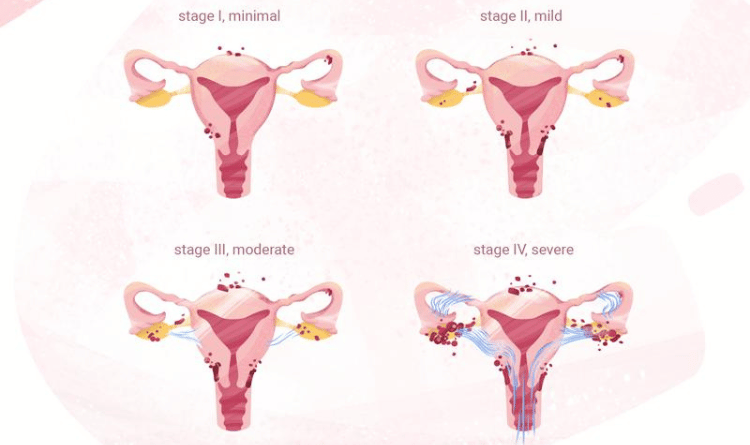
Different factors determining the stage of the disorder include the location, number, size, and depth of endometrial implants. Endometriosis has the following four stages or types:
- Minimal - In minimal endometriosis, small lesions, wounds, and shallow endometrial implants on your ovaries. You may also have inflammation in or around your pelvic cavity.
- Mild - Mild endometriosis refers to light lesions and shallow implants found on the ovaries and pelvic lining.
- Moderate - In cases of moderate endometriosis, there are numerous deep implants on the ovaries and pelvic lining and a possibility of additional lesions.
- Severe - In the advanced stage of endometriosis, numerous deep implants are present on the pelvic lining and ovaries. Additionally, there may be lesions on the fallopian tubes and bowels and cysts on one or both ovaries.
What are the Symptoms of Endometriosis?
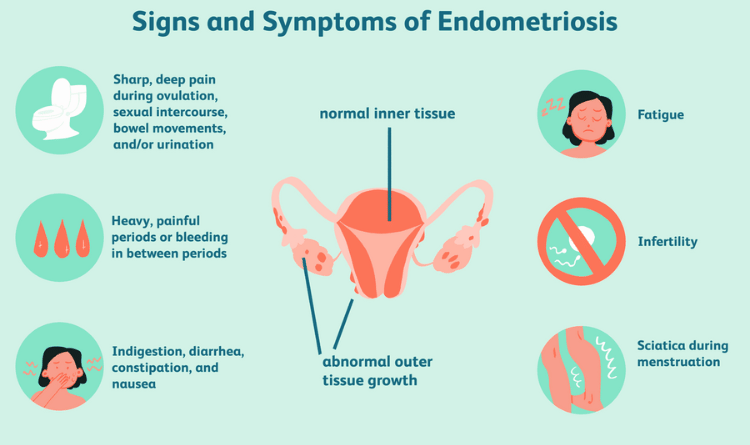
The most common signs of endometriosis are infertility and pain. The pain typically presents as:
- Pain during or after sex
- Menstrual cramps can be painful and may be felt in the abdomen or lower back.
Other symptoms may include:
- Diarrhea or constipation during the menstrual cycle
- Fatigue/low energy
- Heavy or irregular menstrual cycles
- Spotting or bleeding between menstrual cycle
- Pain with urination or bowel movements during the menstrual cycle
It's important to understand that endometriosis can affect each person differently. Women with endometriosis may experience some, all, or none of the common symptoms associated with this condition. It's also worth noting that experiencing severe symptoms does not necessarily indicate more severe endometriosis.
What is the Treatment of Endometriosis?
The appropriate treatment involves considering various aspects, such as the patient's age and symptoms. Additionally, the doctors will inquire about your desire to have children, as this can aid in identifying the most suitable treatment alternatives.
Non-surgical Endometriosis Treatments
The most common treatments for endometriosis are hormone therapy and pain management.
There are treatments available, such as hormone therapy, that can change the levels of hormones in your body or prevent the production of specific hormones. Hormone therapy can be administered through injections, tablets, or a nasal spray.
There are several common options available to manage symptoms related to hormones. These options include:
- Using oral contraceptives containing estrogen and progesterone
- Using a gonadotropin-releasing hormone antagonist to limit ovarian hormone production
- Taking progestins to stop menstrual periods and endometrial tissue growth
- Using a gonadotropin-releasing hormone agonist to stop ovarian hormone production.
Managing endometriosis pain can be effectively done using medications like nonsteroidal anti-inflammatory drugs (NSAIDs).
Surgical Treatment of Endometriosis
Laparoscopy for Endometriosis
Patients with more advanced endometriosis, pain not resolving with other treatments, or trying to conceive may need surgery. Laparoscopy is the most common surgery performed by doctors to treat endometriosis.
What happens during laparoscopy?
- The surgeon creates a few small incisions in your abdomen during the surgical procedure.
- A thin tube with a light and camera is inserted through one of the incisions, while small tools are inserted through the other incisions.
- These tools can either remove endometrial tissue through excision or destroy the tissues using intense heat through ablation.
In addition to other procedures, the surgeon can eliminate any scar tissue that may have developed in the surrounding region. Laparoscopic surgeries typically carry a shorter recovery period and less noticeable scarring than traditional open surgery, known as laparotomy.
Laparotomy for Endometriosis
Sometimes, a doctor may opt for a laparotomy instead of a laparoscopy to treat endometriosis. This involves making a bigger incision in the abdomen to remove the endometrial tissue. However, this is not a common procedure.
While using laparoscopy or laparotomy to remove endometrial tissues can offer temporary relief from pain, the pain can recur.
Hysterectomy for Endometriosis
If you are diagnosed with endometriosis, your doctor may recommend a hysterectomy, a surgical procedure that involves removing the uterus. Sometimes, your doctor may also recommend removing your ovaries (oophorectomy) and the uterus. This will stop hormone release and effectively treat endometriosis but also induce menopause.
Although removing the ovaries can significantly reduce estrogen levels and prevent the growth of endometrial tissue, it also entails the risks and side effects of menopause. These include hot flashes, bone loss, heart disease, reduced sex drive, memory problems, and anxiety or depression. As a result, the decision to undergo oophorectomy is based on individual factors and personal goals discussed between the patient and their doctor.
After a hysterectomy, you will not have a uterus and, therefore, won't be able to conceive or carry a pregnancy. If you want a child, speak to your doctor about other options.
If you have had an oophorectomy but still have your uterus, you may be able to get pregnant through in vitro fertilization (IVF). Your doctor can extract eggs from your ovaries before surgery and preserve them for later fertilization and implantation, or you can use an egg donor. It takes about one week for 1 cycle and the cost of IVF treatment in Thailand depends on the approach being utilised.
Top Doctors in Thailand for Endometriosis Treatment
Some of the leading IVF doctors in Thailand providing treatment for endometriosis are listed below:
- Dr. Jongjate Aojanepong: He is a renowned Obstetrician and Gynecologist with over 43 years of experience. His specializations include infertility treatment and reproductive medicine.
- Dr. Kriengchai Sajjachareonpong: He is a well-known Obstetrician and Gynecologist with over 32 years of experience. His areas of expertise lie in IUI, IVF, ICSI, Laparoscopic surgery, etc.
- Dr. Saranya Chanpanitkitchot: He is a well-known Gynecologic Oncologist with over 18 years of experience. Her interests include minimally invasive surgery and gynecologic oncology.
- Dr. Viwat Chinpilas: He is an IVF Specialist with over 39 years of experience in offering fertility treatments. He is an expert at conducting ART treatments. He treats IVF pelvic endometriosis and performs endoscopic surgery and surgical correction of myoma uteri.
- Dr. Boonsaeng Wuttiphan: He is a leading Obstetrician & Gynaecologist, and Infertility Expert with over 21 years of experience. He treats gynecological conditions such as high-risk pregnancy, hypertension in pregnancy, hormonal disorders, endometriosis, menstruation problems, and family planning, among other conditions.
Key Takeaway
Thailand boasts hospitals with top-notch medical facilities and a team of highly experienced doctors and supporting staff. Patients can expect an international standard of medical care, with quality diagnosis, treatment, and preventive health services on par with the world's best hospitals. The hospitals' modern infrastructure supports their advanced facilities, making it an ideal destination for treating endometriosis.



 Chat
Chat