

Dr Kiran Shah is a best Colo-Rectal Surgeon in Mumbai with over 27 years of expertise in general and laparoscopic surgery. He is a skilled general and laparoscopic surgeon who can treat haemorrhoids, anal fissures, anorectal abscess and fistulas, pilonidal sinuses, anal stenosis, prolapse rectum, and anal incontinence. Other operations he does include cholecystectomy, laparoscopic cholecystectomy/hernia, open hernia, thyroid, breast, and appendectomy. he is currently associated with Apollo Spectra Hospital, Mumbai.

Dr Shah completed his MBBS from Mumbai University in 1982, followed by MS from Grant Medical College, JJ Group of Hospitals Mumbai in 1985, and a fellowship from the Association of Colon & Rectal Surgeons of India. He also received training in colon and rectal surgery, the care of long-term piles, rectal haemorrhage, advancements in anorectal illness, a novel approach to pilonidal sinus, and haemorrhoids. he is an active member of the Association of Colon and Rectal Surgeons of India, the Bombay 'C, D, & E' Ward Medical Association, and the Indian Medical Association and also addresses conferences regularly. he has work experience as a Consultant for many years in Apollo Spectra Hospital, Mumbai.
List of treatments by Dr Kiran Shah
- Inguinal Hernia Repair Surgery
- Breast - Wide Excision and Axillary Sample
- Cholecystectomy - Gall Bladder Removal
- Pilonidal Sinus
- Haemorrhoids Treatment
- Stapled Haemorrhoidectomy (Piles)
- Appendectomy
- Hemorrhoidectomy
What are Colorectal surgeons?
Colorectal surgeons are experts who specialise in the physiology of the lower digestive system. The term "colorectal" is derived from the words colon and rectal. The colon, rectum, pelvic floor, and anus, sometimes known as the small intestine, are all located in this part of the body. they are highly skilled subspecialists who utilise medical and surgical procedures to diagnose and treat a wide range of problems such as infections, incontinence and cancer.
What is Haemorrhoids?
Haemorrhoids are swelling, bulging veins that develop within and outside of the anus and rectum. They can be painful and uncomfortable, and they might result in rectal bleeding. Haemorrhoids are also known as piles. We are all born with haemorrhoids, yet they do not bother us. Only when they grow swollen and enlarged can they produce irritating symptoms. When the veins grow and their walls become strained, thin, and irritated by passing stool, haemorrhoids can swell. Haemorrhoids are divided into two types:
- internal, originating in the rectum.
- external, originating in the anus.
Symptoms
Around half of the population has experienced one or more of the typical symptoms by the age of 50, which include rectal discomfort, itching, bleeding, and perhaps prolapse (haemorrhoids that protrude through the anal canal). Although haemorrhoids are rarely harmful, they can be a painful and recurrent intrusion. Internal haemorrhoids are located within the rectum. They are rarely visible or felt, and they rarely cause discomfort. However, straining or discomfort when passing stool might result in:
- Painless bleeding, you may notice a small amount of blood in the toilet.
- A haemorrhoid to push through the anal opening, resulting in pain and irritation.
External haemorrhoids are lower than internal haemorrhoids and are found on the surface of the skin that surrounds the anus. They may be felt when they swell and may cause discomfort. Itching or irritation in your anal region, Pain or discomfort, swelling around your anus, bleeding.
Treatments
- Medication: Your doctor may recommend over-the-counter lotions, ointments, suppositories, or pads if your haemorrhoids are only causing little discomfort. These treatments contain ingredients including witch hazel, hydrocortisone, and lidocaine, which can relieve pain and irritation for a short period.
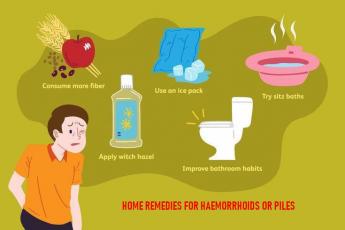
- Home remedies: Drink a lot of water throughout the day, Consume additional high-fibre foods (fresh fruits and vegetables, whole grains) or take fibre supplements, Take laxatives or use enemas only as directed by your doctor.
- Rubber band ligation: a tiny elastic band is wrapped around the base of the haemorrhoid As it heals, the band forces haemorrhoid to shrink and the surrounding tissue to scar, which keeps the haemorrhoid in place. To fully remove haemorrhoids, two to four procedures must be performed six to eight weeks apart.
- Surgical removal of hemorrhoids, known as a hemorrhoidectomy or stapled hemorrhoidectomyInternal and external haemorrhoids are removed during an excisional hemorrhoidectomy. The removal incisions might be sutured (sewn) together (closed method) or left open (open technique). The outcomes of both approaches are similar.
- The stapled hemorrhoidectomy (also known as the “stapled hemorrhoidopexy”) is a relatively new surgical procedure that is quickly becoming the treatment of choice for third-degree haemorrhoids. This procedure does not remove the haemorrhoids, but rather the enlarged hemorrhoidal supporting tissue that has caused the haemorrhoids to slide lower.

 Chat
Chat