

How Much does Pancreatic Cancer Cost
Pancreatic cancer is counted amongst the most invasive and fatal form of cancer. Unfortunately, the cancer signs and symptoms are not noticed at an earlier stage. Only when it reaches the 4th stage, the patients start noticing some abnormal symptoms. By this time, the surgical treatment is not possible. Moreover, this type of cancer spreads throughout the body recklessly, hence; immediate treatment is an absolute necessity.
Factors Affecting the Cost of Pancreatic Cancer in India
The overall cost estimate of pancreatic cancer treatment in India depends upon several factors such as,
- The type of pancreatic cancer - The cancer type and the extent of its invasion greatly determines the cost of treatment.
- Diagnostic tests - The number and the type of diagnostic tests needed to reach a final diagnosis also determine the final cost.
- Other medical conditions - Patients who are also suffering from other medical conditions than the pancreatic cancer are difficult to be treated and require doctors with greater expertise, which ultimately leads to an increase in the cost estimate.
- Immuno-compromised patients - Certain patients of pancreatic cancer, who are immuno-compromised are also difficult to be treated as they need to be protected from any possible source of infection.
- The hospital and the location - Sometimes the hospital or the location of the hospital chosen by the patient are expensive, which again increases the overall cost.
Despite all these factors, the overall pancreatic cancer treatment cost in India is approximately 7600 USD.
There are two types of pancreatic cancer, varying with the location of cancerous cells.
- In the head of the pancreas - If the malignant tumor lies in the head of the pancreas, which happens in 60 percent of the cases. This type of tumor is manifested as weight loss, abdominal pain, and jaundice.
- In the tail and body of the pancreas - A small percentage of the cases include invasion of the tail and body of the pancreas, which is manifested as sudden weight loss and abdominal pain.
Other Type of Classification
Another type of classification of pancreatic tumors in the exocrine tumors and endocrine tumors.
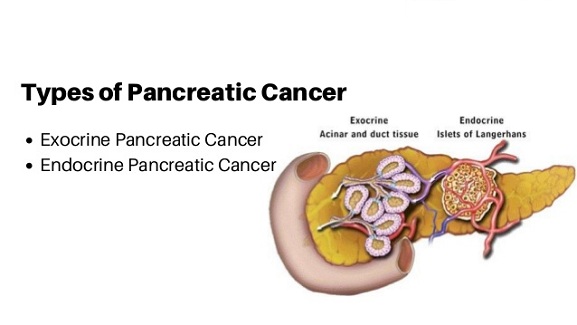
Exocrine tumors - The exocrine glands are those that secrete the enzymes and release on the epithelial surface of the duct. For example, sweat glands, salivary glands, mammary glands, lacrimal glands, etc. The tumors existing in these tumors are known as exocrine tumors. The most common types of exocrine tumors are listed below:
- Ductal adenocarcinoma
- Acinar cell carcinoma
- Adenosquamous carcinoma
- Intraductal Papillary Mucinous Neoplasm
- Mucinous Cystadenocarcinoma
- Pancreatoblastoma
- Serous Cystadenocarcinoma
- Pseudopapillary tumors
Endocrine tumors - The endocrine glands are those, which secrete the enzymes or hormones directly into the blood rather than releasing it through a ductal system. The most common examples of endocrine glands are pineal gland, pituitary gland, etc. The most common endocrine tumors are listed below:
- Glucagonomas
- Insulinomas
- PPomas
- Somatostatinomas
- VIPomas
How is Pancreatic Cancer Diagnosed?
Several types of diagnostic tests and investigations are required to reach a final diagnosis.
Physical exam - This is the first and the foremost examination which is conducted clinically. The doctor will look for the signs of jaundice by looking at the skin and eyes. The abdomen is also examined to look for any changes near the pancreas, liver, or gallbladder and also to check ascites.
Lab investigations - After the doctor finds out any positive signs during the clinical examination, he sends the patient for further lab investigations where blood, urine, and stool samples are taken to check the bilirubin levels and certain other substances. Very high bilirubin levels may be indicative of cancer or certain other non-cancerous conditions.
CT Scan - Computed Tomography scan is done to take images of the pancreas and other nearby organs and blood vessels in the abdomen.
Ultrasonography - It may be a transabdominal ultrasound (done externally)and endoscopic ultrasound (done internally).
Endoscopic Retrograde Cholangiopancreatography (ERCP) - An instrument called an endoscope is passed through the patient’s mouth to the first part of the small intestine. In this way, the x-ray pictures of the bile ducts and the pancreatic ducts to check if they are blocked or narrowed by a tumor or any other condition.
PTC (Percutaneous Transhepatic Cholangiography) - A dye is injected through a needle inserted through the skin into the liver. If there is no blockage, the dye moves freely through the ducts, whereas if the dye is accumulated at one place, it may indicate a blockage from a tumor or any other condition.
Biopsy - In some of the complicated cases, the doctor may also need to remove a part of the affected tissue. This tissue sample is sent for the lab investigations to look for cancer cells under a microscope. The tissue sample is either obtained by fine-needle aspiration, during ERCP, or during an operation from an open abdomen.
Written by
Dr. Kavreen Arora
Vaidam Health · Updated 25 Sept 2026
Content meets the Vaidam Policy and is medically reviewed
Medically reviewed by
Dr. Bhawana Mittal Chat
Chat