

Neurosurgery in Germany: Procedures, Costs, and Top Hospitals
It is estimated that each year 22.6 million people suffer from neurological problems of which 13.8 million patients require neurosurgeries.
Because of the complexity of the nervous tissue and the difficulty to repair them, neuro surgeries are among the most complicated surgeries in the medical field demanding high expertise.
Germany is one of the few advanced countries promising highly advanced healthcare systems. It is ranked 5 for its health care services in the world. One such field is the German neurosurgery field having advanced equipment and highly skilled medical professionals.
What is Neurosurgery?
Neurosurgery deals with the surgical treatment of the neurological problems of the brain, spinal cord, spinal column and peripheral nerves all over the body. Whether it be a neurological disorder or a traumatic brain or spinal cord injury, for an adult or paediatric patient. Neurosurgeries involve minimally invasive and open surgeries with highly advanced equipment.
What Health Conditions Require Neurosurgery?
Neurosurgery is required to be performed in cases of
- Traumatic brain or spine injury
- Sports-related head, spine and neck injuries
- Tumours of pituitary or spinal origin like Craniopharyngiomas, Meningiomas
- Hydrocephalus
- Carotid artery blockages
- Cushing's syndrome
- Spasticity
- Trigeminal neuralgia
- Epilepsy
- Congenital problems in infants having skull deformities like Craniosynostosis, Positional Plagiocephaly, Apert’s syndrome, Crouzon’s syndrome
- Other paediatric and neonatal problems like Spina Bifida
- Cerebrovascular problems including aneurysms and arteriovenous malfunctions.
What Procedures or Techniques are Followed in Neurosurgery?
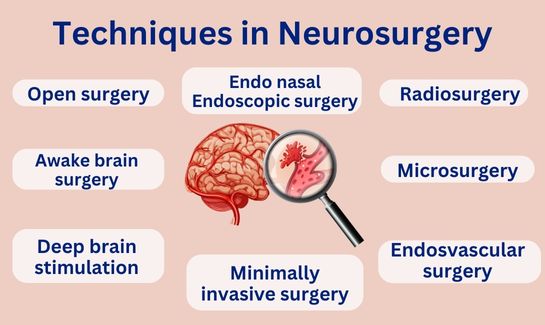
The progress in science and technology has combined several advanced techniques into neurosurgical procedures.
- Open surgery: It is also called craniotomy where the neurosurgeons make a small hole called a bone flap to access the internal soft brain tissues. After the surgical process, the bone flap is secured back on the skull with the help of screws and pallets.
- Minimally invasive surgery: Small holes are made in the cranium and an endoscope is inserted into the hole for the operating purpose. Minimally invasive surgeries are associated with the least damage to the body and the doctor operates with precise equipment. These surgeries ensure faster healing and recovery due to small incisions.
- Endonasal Endoscopic surgery: The endoscope is inserted into the nasal passages to treat the tumours or problems of the frontal parts of the brain.
- Radiosurgery: The neurosurgeries employed through radiosurgical procedures are concerned with the treatment of brain and other neurological tumours by focusing the high-intensity radiations over a small specific target area having a tumour.
- Microsurgery: The abnormal brain swellings or aneurysms are treated through microsurgeries where highly precise microscopes and neuro-endoscopes are employed in the surgery. This ensures the correct blood vessels or arteries are being operated leaving the surrounding ones open and unblocked.
- Endovascular surgery: Similar to endo-nasal endoscopic surgeries, endovascular neurosurgery also involves the passing of tools however this is into the patient's blood vessels to diagnose and treat the particular disease condition.
- Deep brain stimulation: A pulse generator is placed inside the brain to generate electrical impulses. Minimally invasive approaches are followed in this kind of neuro surgeries.
- Awake brain surgeries: The neurosurgeon operates on the patient by checking his responses. This is done while the patient is awake under pain-relieving local anaesthesia. This is performed for correcting the abnormalities of speech, vision, and seizures and the doctor checks for the patient's responses during the operating procedure.
In computer-assisted brain surgeries, the imaging techniques like computer tomography (CT), magnetic resonance imaging (MRI), positron emission technique (PET) and intraoperative MRI are used to support the ongoing surgical process.
In these neurosurgeries, the neurosurgeons understand the 3D structure of the brain and perform the surgical procedure for precision and best outcomes.
On a whole, neuro surgeries are quite complicated surgeries and it is the expertise of the neurosurgeon that ensures the success of neurosurgery.
How Long Does Neurosurgery Take?
It can take around 2-9 hours or sometimes even more for a neurosurgeon to perform neurosurgery. In complex surgeries, it can take even longer time.
Most patients will be discharged within a few days post-surgery. They are evaluated on all basis including brain functioning, physical therapies, and occupational therapies.
Is It Required to Follow Any Post-Surgery Care?

Post neurosurgery, most patients are allowed to be placed in a comfortable position with their head in elevation in order to reduce the chances of swelling in the head region.
During discharge, the patients are instructed about post-care tips. Some patients require a rehabilitation stay based on the medical ailment being treated.
Pain medication is prescribed for a certain period. Patients will be advised to avoid strenuous activities and mental pressures for certain periods until a full-fledged recovery.
A medical follow-up post-discharge is essential to ensure the healing and progressive functioning of the nervous system.
Are There Any Side Effects in Undergoing Neurosurgery?
The patients are discharged only after a complete evaluation and when the doctors believe that the patient is doing well post-surgery.
Certain medications like steroids prescribed post-neurosurgery may cause insomnia, agitation, sweating, and breathing problems.
It is essential for the patient to keep a check on the frequency of symptoms and report to the doctor during their follow-up visits.
Any recurrent headaches, seizures, swelling in the head portion, bleeding, memory problems, or inability of eye coordination, balance and speech should never be ignored and be immediately reported to the concerned doctor during the post-neurosurgery period.
Why Should One Choose Germany for Neurosurgery?
Germany is one such country that offers the best healthcare services. And with respect to neurosurgery, German neurosurgeons are highly qualified specialists. They follow the latest up-to-date protocols and surgical procedures.
German neurology centres have the latest diagnostic tools and minimally invasive operating equipment that comply with International quality standards.
How Much Does it Cost for Undergoing Neurosurgery In Germany?
Neurosurgery is one of the most complicated surgeries in healthcare. Requiring sophisticated equipment and advanced diagnosing and intraoperative tools, neurosurgery is one of the cost-associated treatments in the healthcare world.
Costs related to some commonly operated neurosurgeries in Germany
|
Treatment name |
Cost starts from (USD) |
|
9000 |
|
|
10,500 |
|
|
Blood Clot Brain Surgery |
10,000 |
|
10,000 |
|
|
10,400 |
|
|
Laminectomy |
11,000 |
Although these are the starting costs, the actual cost for treatment may vary for each surgery depending on the complexity of the health problem, the use of special equipment or diagnosing tools, level of hospital chosen by the patient.
How to Proceed With a Medical Visa for Neurosurgery in Germany?
To proceed with neurosurgery in Germany, the patients must arrange for a medical visa from the German authorities.
The required documents are
- A medical certificate from a physician stating the medical condition and requirements of the neurosurgery.
- Documents reflecting the German hospital and concerned neurosurgery experts agreeing to treat the particular patient.
- Valid passport
- Proofs of civil status
- Proofs of financial status
- European health insurance and related papers
Top Hospitals for Neurosurgery in Germany
Here we have highlighted some of the top hospitals for neurosurgery in Germany, showcasing their excellence and dedication to patient care.
-
Helios Hospital, Berlin: It is accredited with ISO 9001 international standard quality to ensure quality treatment. This group of hospitals have a special foreign department to help with foreign patients from different nations.
-
University Hospital, Heidelberg: It is one of the oldest hospitals in Germany and treats over 1 million outpatients each year.
-
Meoclinic Hospital, Berlin: This hospital is certified for ISO 9001:2008 quality standards and has the latest equipment for the neurosurgery and neurology department. This hospital offers the best care for paediatric neurological surgeries.
-
Carl Gustav Carus University Hospital, Dresden: This hospital was listed Top National Hospital Award by Focus Health Magazine in 2020. The neurosurgeons in this hospital use the latest MRI-3 Tesla for monitoring the patient's condition during the ongoing surgery.
-
University Hospital Erlangen, Erlangen: According to Focus magazine, this hospital ranked 15 of 1170 medical facilities across Germany. Here the neurology department has 14 specialised intensive care units. The advanced equipment for neuronavigation, high precision microscopes, MRI (1.5 tesla) and spiral imaging CT scanner are used for the neurosurgeries in this hospital.
Top Neurosurgeons In Germany
Here we have highlighted some of the most distinguished neurosurgeons in Germany, their specializations, and areas of interest in the field of neurosurgery.
-
Prof. Dr Med. Jurgen Kiwit: He is the leading neurosurgeon with 35+ years of experience in dealing with endoscopic disc surgeries, vertebroplasty and neuronavigation of spinal and cranial surgeries.
-
Prof. Dr Med. Gabriele Schackert: Having 32+ years of experience in neurosurgery, she has a worldwide reputation. Her areas of interest include skull base surgeries, acoustic neuromas, gliomas, and tumour surgeries.
-
Prof. Dr Volker Arnd Coenen: He is a leading neurosurgeon having 15+ years of experience in dealing with some complicated neurosurgeries involving deep brain stimulation, hematoma, hypertensive bleeds, aneurysms and brain tumours.
-
Prof. Dr Med. Rudolf Laumer: He is a well-experienced neurosurgeon with 39+ years of experience in neurosurgeries. His main interest is spinal problems like disc herniations and thoracic and lumbar spinal stenosis.
-
MD Christoph Goetz: He is a renowned neurosurgeon having 35+ years of experience. His area of expertise is deep brain stimulation, cyber knife, gamma knife and spine surgeries.
Role of Vaidam Healthcare
Vaidam has been helping medical travellers from different countries to get the best treatment in the best hospitals in different nations including Germany. To get support from Vaidam’s team, you are free to raise a request quote.
Conclusion
Neurosurgeries are some of the most complicated surgeries in the medical sciences. With the need for special equipment and advanced technology, neurosurgery is a costly process. Germany has several advanced hospitals that have the latest technology and highly skilled medical professionals. So if medical travellers are looking for the best results in neurosurgery, German is a good option for them.
Frequently Asked Questions (FAQs)
-
Are there any risks associated with neurosurgery?
Ans: Although brain surgeries are complicated, a proper diagnosis and expertise of the medical professional can ensure the success of neurosurgery. The common risks are nerve damage, bleeding and coma which are otherwise quite rare.
-
What is the success rate of neurosurgery?
Ans: The success rate of neurosurgery on average is 50-70%.
-
How long does a patient need to stay in the hospital after neurosurgery?
Ans: A patient needs to stay in the hospital for about a week or 10 days post-surgery. Depending on the response towards the surgery and recovery, the hospital stay may vary. The doctors closely examine the brain activity during and after the surgery and in case of any complications noticed, the duration of hospital stay may increase in rare cases.
-
How to choose the neurosurgeon for treatment?
Ans: Based on the medical ailment that the patient has been facing, the treatment differs. It is advisable to choose the neurosurgeon based on their area of interest and their experience in that field. The availability of diagnostic equipment and other related tests at the hospital facility are some points to be considered when choosing a neurosurgeon.
Written by
itikarlapalliprathyusha
Vaidam Health · Updated 25 Sept 2026
Content meets the Vaidam Policy and is medically reviewed
Medically reviewed by
Dr. Shruti Rastogi Chat
Chat