

Stage 4 oesophageal cancer (spelled "esophageal" in American English) means the cancer has spread beyond the oesophagus and nearby tissues. It may have reached distant lymph nodes or organs such as the liver, lungs or bones. At this stage, treatment is usually aimed at controlling the cancer, extending life and keeping swallowing and nutrition as good as possible. A cure is not usually the aim.
Treatment has changed considerably in recent years. Immunotherapy combined with chemotherapy is now a standard first treatment for many patients. Tumour testing for markers such as HER2 and PD-L1 decides which drugs are likely to help.
In Germany, around 7,600 people were diagnosed with oesophageal cancer in 2023. Treatment follows European (ESMO) guidance and a national German S3 guideline.
Stage 4 esophageal cancer treatment in Germany is usually built around systemic therapy, most often chemotherapy combined with immunotherapy or a targeted drug, chosen according to tumour type and biomarker results. Symptom-focused treatments such as stents, radiotherapy and nutritional support run alongside. For selected patients with very limited spread, further local treatment may be discussed within a specialist tumour board.
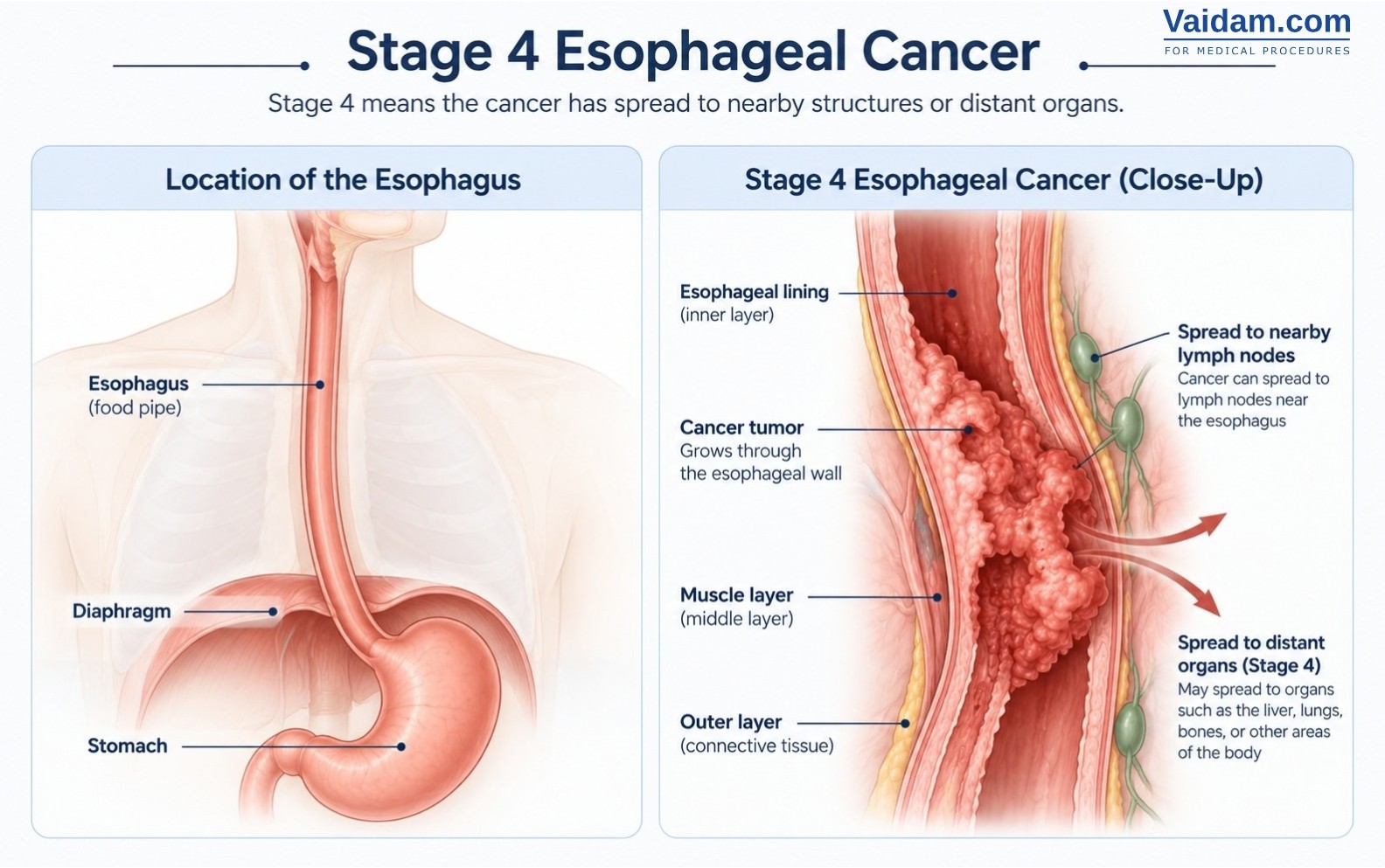
What Does Stage 4 Oesophageal Cancer Mean?
Doctors divide stage 4 into two groups, and the difference matters for treatment.
Stage IVA: The tumour has grown into major neighbouring structures, such as the aorta, windpipe or spine, or has spread to many regional lymph nodes. It has not spread to distant organs. Some patients in this group can still receive intensive treatment with curative intent, usually chemoradiotherapy.
Stage IVB: The cancer has spread to distant organs or distant lymph nodes (metastatic disease). Treatment is mainly systemic, meaning medicines that act throughout the body.
The exact definitions differ slightly between tumour types and staging editions. The treating team will explain which group applies.
Types of Oesophageal Cancer
Almost all oesophageal cancers are one of two types. The type affects which drugs are used.
Type | Where it usually develops | Main risk factors | Treatment considerations |
Squamous cell carcinoma (SCC) | Upper and middle oesophagus | Smoking and alcohol, especially together | Responds to chemotherapy and radiotherapy; PD-L1 testing guides immunotherapy |
Adenocarcinoma | Lower oesophagus and the junction with the stomach | Long-term acid reflux, Barrett's oesophagus | Tested for HER2, PD-L1, MSI and, at the stomach junction, Claudin 18.2 |
In Germany, adenocarcinoma now accounts for slightly more cases than squamous cell carcinoma.
Symptoms of Advanced Oesophageal Cancer
The most common symptom is difficulty swallowing (dysphagia). It usually starts with solid food and later affects soft food and liquids. Other symptoms include:
Unintended weight loss
Pain behind the breastbone or when swallowing
Food coming back up (regurgitation)
A persistent cough or hoarseness
Tiredness from anaemia or poor nutrition
Symptoms from metastases, such as bone pain or breathlessness
Early oesophageal cancer often causes no symptoms. This is one reason only about one in three cases in Germany is found at an early stage.
How Is Stage 4 Oesophageal Cancer Diagnosed and Assessed?
Endoscopy and Biopsy
A flexible camera (upper endoscopy) examines the oesophagus. The doctor takes tissue samples to confirm cancer and its type. Enough tissue for biomarker testing is essential in stage 4, because the results decide treatment. If the original sample is small, a new biopsy may be needed.
Imaging
A CT scan of the chest and abdomen shows how far the cancer has spread. PET-CT may be used when it could change the plan, for example to check whether metastases really are limited. Endoscopic ultrasound is mainly used in earlier stages.
Biomarker Testing
Biomarker testing is now a routine part of planning treatment for advanced disease.
Biomarker | Tested in | Why it matters |
HER2 | Adenocarcinoma | HER2-positive tumours can be treated with trastuzumab-based therapy |
PD-L1 (CPS or TAP score) | Both types | Higher levels predict greater benefit from immunotherapy; approvals depend on the score |
MSI / dMMR | Both types | Microsatellite-unstable tumours often respond well to immunotherapy |
Claudin 18.2 | Adenocarcinoma at the stomach junction | Positive, HER2-negative tumours may be eligible for zolbetuximab |
Fitness Assessment
Doctors also assess general fitness (performance status), nutrition, kidney and liver function, and other illnesses. These factors decide how intensive treatment can safely be.
Stage 4 Esophageal Cancer Treatment Options in Germany
How is stage 4 oesophageal cancer treated?
Treatment depends on the tumour type, biomarker results, where the cancer has spread, symptoms and the patient's fitness. Most patients receive systemic therapy, often combining chemotherapy with immunotherapy or a targeted drug. Symptom control and nutritional support run alongside. Local treatments such as radiotherapy or surgery are used only in selected situations.
First-Line Systemic Therapy
The first treatment after diagnosis usually combines a platinum drug (cisplatin or oxaliplatin) with a fluoropyrimidine (5-FU or capecitabine). A second medicine is added based on biomarkers.
Squamous cell carcinoma:
Chemotherapy plus a PD-1 inhibitor, such as nivolumab, pembrolizumab or tislelizumab, depending on PD-L1 level and local approval
Nivolumab plus ipilimumab, a chemotherapy-free immunotherapy combination, as an alternative for selected PD-L1-positive patients
Adenocarcinoma, HER2-negative:
Chemotherapy plus nivolumab or pembrolizumab when PD-L1 is expressed
Chemotherapy plus zolbetuximab for Claudin 18.2-positive tumours at the stomach junction
Adenocarcinoma, HER2-positive:
Chemotherapy plus trastuzumab, with pembrolizumab added when PD-L1 is expressed
In the EU, approvals are tied to specific PD-L1 thresholds and tumour locations. A drug that suits one patient may not be approved or reimbursed for another with a similar diagnosis. The treating oncologist confirms which options apply.
Treatment is usually given in cycles every two or three weeks. After a period of combination therapy, some patients continue on immunotherapy or a lighter regimen (maintenance) for as long as it works and side effects are manageable.
Second-Line and Later Treatment
If the cancer grows despite first treatment, further options include:
Adenocarcinoma: paclitaxel with ramucirumab; trastuzumab deruxtecan for HER2-positive disease after trastuzumab; other chemotherapy combinations
Squamous cell carcinoma: nivolumab if no immunotherapy was used before; taxane-based chemotherapy
Clinical trials, which can give access to treatments under study
The German S3 guideline recommends offering a checkpoint inhibitor after first-line failure if the patient has not already received immunotherapy.
Radiotherapy
In stage 4, radiotherapy is mainly used to relieve symptoms:
External beam radiotherapy can shrink the tumour to improve swallowing, stop bleeding or ease pain from bone metastases.
Brachytherapy places a radiation source inside the oesophagus through a thin tube. It can relieve dysphagia in selected patients.
For stage IVA disease without distant spread, definitive chemoradiotherapy (chemotherapy and radiotherapy together) may be used with curative intent.
Relief of Swallowing Problems
Keeping the patient able to eat and drink is central to care at this stage.
Self-expanding metal stents are placed during endoscopy to hold the oesophagus open. They usually improve swallowing within days.
Feeding tubes support nutrition when swallowing is not possible.
Dilatation (stretching the narrowed area) or radiotherapy may be used in some cases.
The best option depends on tumour position, how long relief is needed and whether radiotherapy is planned.
Limited Metastatic (Oligometastatic) Disease
A small group of patients have only a few metastases, sometimes called oligometastatic disease. For them, surgery or targeted radiotherapy to all visible cancer after good response to chemotherapy is sometimes discussed.
The evidence is still developing. German researchers ran the phase III RENAISSANCE trial in limited-metastatic adenocarcinoma of the stomach and gastro-oesophageal junction. It tested whether surgery after FLOT chemotherapy improves survival compared with chemotherapy alone. The results were presented in 2024 and suggested a possible benefit mainly in patients whose spread was limited to retroperitoneal lymph nodes. The trial did not show that surgery helps limited-metastatic patients in general.
Any local treatment in stage 4 should be decided by an experienced multidisciplinary tumour board. It is only an option for patients whose cancer responds well to systemic therapy.
Palliative and Supportive Care
Palliative care means specialist care focused on symptoms and quality of life. It is not only for the final weeks of life. Starting it alongside cancer treatment helps with:
Pain control
Nutrition, including dietitian support
Nausea, fatigue and breathlessness
Psychological support for patients and families
Planning for future care wishes
German cancer centres include palliative medicine and psycho-oncology services, and certified centres are required to provide them.
Treatment | When it may be used | Things to consider |
Chemotherapy + immunotherapy | First-line for many SCC and HER2-negative adenocarcinoma patients | Depends on PD-L1 score; immune side effects can affect any organ |
Chemotherapy + trastuzumab (± pembrolizumab) | HER2-positive adenocarcinoma | Heart function monitored |
Chemotherapy + zolbetuximab | Claudin 18.2-positive, HER2-negative junction adenocarcinoma | Nausea and vomiting common early in treatment |
Second-line therapy | After progression on first treatment | Options depend on tumour type and earlier drugs |
Palliative radiotherapy / brachytherapy | Dysphagia, bleeding, bone pain | Relief can take a few weeks |
Oesophageal stent | Severe dysphagia | Quick relief; possible pain, reflux or stent movement |
Definitive chemoradiotherapy | Selected stage IVA without distant spread | Intensive; curative intent in some cases |
Surgery or local therapy for metastases | Highly selected oligometastatic cases | Still being evaluated; specialist tumour board decision |
What Outcomes Can Patients Expect?
Stage 4 oesophageal cancer has a serious outlook, and honest information helps families plan.
In US population data for 2015 to 2021, five-year relative survival for oesophageal cancer that had spread to distant sites was about 5%. These figures come from patients treated before immunotherapy was widely used, so they may not reflect current care.
In the CheckMate 649 trial, which led to a first-line approval for adenocarcinoma, median survival was 14.4 months with nivolumab plus chemotherapy and 11.1 months with chemotherapy alone, in patients with PD-L1 CPS of 5 or higher. Trial participants are generally fitter than average.
Individual outcomes vary widely. Some patients respond well and live considerably longer than average, while others cannot tolerate intensive treatment. The treating oncologist is best placed to discuss what is realistic for a specific patient.
Why Consider Germany for Stage 4 Oesophageal Cancer Treatment?
Standard first-line drugs are available in many countries, and ongoing treatment every few weeks is easiest close to home. For stage 4 disease, travelling abroad is most worth weighing for specific purposes:
A second opinion and treatment plan, including a review of staging and biomarker results
Complete biomarker testing when it was not fully done at home
Assessment for limited metastatic disease, where specialist tumour boards decide whether local treatment makes sense
Clinical trials not available in the home country
Complex endoscopy, such as stent placement in difficult positions
Features of the German system relevant to these purposes:
National guideline: Germany's S3 guideline on oesophageal cancer (version 4.0, December 2023) sets out evidence-based recommendations, including immunotherapy in first-line treatment.
Certified oesophageal cancer centres: The German Cancer Society (DKG) certifies specialist oesophageal cancer centres (Speiseröhrenkrebszentren), which are audited every year. These centres can be searched on the DKG's OncoMap.
Minimum surgical volumes: German hospitals must perform at least 26 complex oesophageal operations a year to offer this surgery. This matters for the few stage 4 patients considered for surgery.
Multidisciplinary tumour boards: Gastroenterologists, surgeons, oncologists, radiation oncologists, pathologists and palliative care specialists review each case together.
A practical point: stage 4 treatment usually continues for months. Many international patients find the most workable plan is a German assessment and treatment plan, followed by ongoing treatment at home, with the German team available for review.
Hospitals in Germany That Treat Oesophageal Cancer
The hospitals below have publicly documented oesophageal cancer programmes. They are listed alphabetically by city, and the order is not a ranking. Certifications are reviewed every year, so current status should be confirmed on the German Cancer Society's OncoMap before making a decision.
University Hospital Cologne (CIO Köln)
Location: Cologne
Type: University hospital
The oesophageal cancer centre at the Centre for Integrated Oncology Cologne has held DKG certification since 2019. It is part of a visceral oncology centre, certified since 2016. The surgical department holds the German Society for General and Visceral Surgery's (DGAV) excellence certification for stomach and oesophageal surgery. In 2021 it reported around 200 oesophageal cancer operations a year.
May suit: patients being assessed for limited metastatic disease or stage IVA disease, where surgical experience is part of the decision.
Evangelisches Krankenhaus Düsseldorf (EVK)
Location: Düsseldorf
Type: Non-university hospital
The oesophageal cancer centre received DKG certification in 2021. The hospital's endoscopy department has been recognised as a Center of Excellence by the World Endoscopy Organization since 2007.
May suit: patients whose main need is endoscopic treatment, such as stent placement for swallowing problems.
University Hospital Erlangen
Location: Erlangen
Type: University hospital
The oesophageal cancer centre is DKG-certified and part of the hospital's oncology centre. Cases are discussed in daily tumour boards, and the hospital runs clinical trials. It reports exceeding the legal minimum of 26 oesophageal operations a year.
May suit: patients interested in clinical trials alongside standard treatment.
Heidelberg University Hospital
Location: Heidelberg
Type: University hospital
Since 2018, the Department of General, Visceral and Transplant Surgery has held DGAV excellence certification for upper gastrointestinal surgery. The certification includes external review of diagnostics, intensive care and structured follow-up.
May suit: patients who may need surgical assessment as part of their plan.
University Hospital Schleswig-Holstein, Campus Lübeck (UKSH)
Location: Lübeck
Type: University hospital
The oesophageal cancer centre at Campus Lübeck is DKG-certified and part of the University Cancer Center Schleswig-Holstein. The surgical department also holds DGAV excellence certification for minimally invasive surgery.
May suit: patients in or near northern Germany and Scandinavia.
München Klinik Bogenhausen
Location: Munich
Type: Municipal hospital
Bogenhausen was the first DKG-certified oesophageal cancer centre in Munich. The hospital is also certified as a visceral oncology centre covering cancers of the digestive tract.
May suit: patients who want treatment at a certified centre in southern Germany.
Klinikum Ernst von Bergmann, Potsdam
Location: Potsdam (near Berlin)
Type: Non-university hospital
The oesophageal cancer centre has held DKG certification since September 2021 and is part of the hospital's certified oncology centre. The hospital reports that it meets the required minimum of 26 oesophageal operations a year.
May suit: patients who want a certified centre near Berlin.
A note on choosing: For most stage 4 patients, the deciding factors are access to biomarker testing, modern systemic therapy, an experienced tumour board and good palliative care. These are available at all of the centres above. Surgical volume and trial access matter most for the smaller group being assessed for local treatment. The "May suit" notes help match a hospital to a situation. They do not mean one hospital is better than another.
How Much Does Stage 4 Oesophageal Cancer Treatment Cost in Germany?
Stage 4 esophageal cancer treatment programs in Germany typically range from €25,000 to €60,000 ($27,000 to $65,000 USD) for comprehensive or advanced individualized care plans. Costs depend on the drugs used, the number of cycles, hospital stays, procedures and supportive care. Vaidam Health does not publish a price range here, because a single figure would mislead for a treatment that varies so widely and often continues for months.
What drives the total cost:
Factor | Why it affects cost |
Drug choice | Immunotherapy and targeted drugs cost considerably more than chemotherapy alone |
Number of cycles | Stage 4 treatment often continues for months, so each cycle adds cost |
Biomarker testing | HER2, PD-L1, MSI and Claudin 18.2 tests, and repeat biopsy if needed |
Imaging | CT or PET-CT for staging and response checks every few cycles |
Procedures | Stent placement, feeding tube insertion, radiotherapy courses |
Hospital stays | Complications such as infection, bleeding or dehydration may need admission |
Supportive care | Nutrition, pain control, managing immunotherapy side effects |
Optional services | Chief-physician care, single rooms, interpreters |
Non-medical costs | Flights, visas, accommodation and a companion's stay |
When requesting estimates, ask whether the quote covers one cycle or a full course. Also ask what happens to costs if the plan changes after the first scan.
How to Choose a Hospital or Specialist in Germany
These criteria can be checked directly:
DKG certification as an oesophageal cancer centre or visceral oncology centre (check OncoMap)
A weekly or daily multidisciplinary tumour board that includes gastroenterology, surgery, medical oncology, radiation oncology, pathology and palliative care
In-house biomarker testing for HER2, PD-L1, MSI and Claudin 18.2
Interventional endoscopy experience with stents and nutrition access
Palliative care and psycho-oncology services
Clinical trials for oesophageal or gastro-oesophageal cancer
Surgical caseload, if local treatment is being considered
International patient support: written estimates, interpreters, visa invitation letters, and a plan for continuing treatment at home
What International Patients Should Prepare
Complete records speed up review and make cost estimates more accurate:
Endoscopy and biopsy reports
Pathology report with any biomarker results (HER2, PD-L1 score, MSI), and tissue blocks if further testing may be needed
CT, PET-CT or MRI reports, plus the original images on disc or via download link
Recent blood tests, including kidney and liver function
Details of any previous chemotherapy, immunotherapy or radiotherapy: drugs, doses, cycles, dates and response
Current medications and allergies
A summary of symptoms, especially swallowing ability and weight change
A passport copy, and later the hospital's invitation letter for a medical visa
Reports not in English or German may need certified translation.
Before travelling: patients with severe swallowing problems, significant weight loss or poor fitness may need stabilisation first. Nutritional support or a stent may be needed before a long journey. Discuss fitness to fly with the home doctor.
Questions to Ask the Treating Team
Is my cancer stage IVA or IVB, and does that change the goal of treatment?
Is it squamous cell carcinoma or adenocarcinoma?
Have HER2, PD-L1, MSI and, if relevant, Claudin 18.2 been tested? What were the results?
Which first-line treatment do you recommend, and why?
What are the aims of treatment: longer life, symptom relief, or both?
How will you manage my swallowing and nutrition?
Am I a candidate for any clinical trial?
Could my disease count as limited metastatic, and would local treatment be considered?
How often will scans be done, and what happens if the cancer grows?
Which parts of treatment can continue in my home country?
When should palliative care be involved?
Living With Treatment and Follow-Up
Response to treatment is usually checked with CT scans every two to three months. If the cancer is controlled, treatment continues. If it grows, the team discusses next-line options.
Common side effects include:
Chemotherapy: fatigue, nausea, low blood counts, numbness or tingling in the hands and feet (neuropathy)
Immunotherapy: inflammation affecting organs such as the skin, bowel, lungs, liver or hormone glands. These effects can appear at any time, even after treatment ends, and need prompt reporting.
Trastuzumab: effects on heart function, monitored with heart scans
Nutrition deserves ongoing attention. Weight loss weakens the body's ability to tolerate treatment. Dietitian support, texture-modified food and supplements can help. Some patients temporarily need a feeding tube.
Frequently Asked Questions
Can stage 4 esophageal cancer be cured?
In most cases, stage 4 oesophageal cancer that has spread to distant organs cannot be cured. Treatment aims to control the cancer, extend life and maintain quality of life. Some patients with stage IVA disease, without distant spread, may still receive chemoradiotherapy with curative intent. A small number with very limited metastases are assessed for more intensive treatment by specialist teams.
What is the first treatment for stage 4 oesophageal cancer?
Most patients start with systemic therapy. This usually means platinum-based chemotherapy combined with immunotherapy, trastuzumab or another targeted drug, depending on tumour type and biomarker results. The exact choice depends on HER2 status, PD-L1 score, MSI status and Claudin 18.2 status. Symptom treatments such as stents or radiotherapy may be given alongside.
Is immunotherapy available for oesophageal cancer in Germany?
Yes. The German S3 guideline recommends chemotherapy combined with a checkpoint inhibitor as first-line treatment for many patients with advanced oesophageal cancer. Drugs such as nivolumab, pembrolizumab and tislelizumab are approved in the EU for specific tumour types and PD-L1 levels. The treating oncologist confirms whether a patient's tumour meets the approval criteria.
Why is biomarker testing important?
Biomarker results decide which medicines are likely to work. HER2-positive adenocarcinoma can be treated with trastuzumab. PD-L1 levels guide immunotherapy. MSI-high tumours often respond well to immunotherapy. Claudin 18.2-positive tumours at the stomach junction may be eligible for zolbetuximab. Without these results, patients may miss suitable treatments.
Which hospitals in Germany treat oesophageal cancer?
Many German hospitals hold DKG certification as oesophageal cancer centres. Examples include University Hospital Cologne, University Hospital Erlangen, UKSH Campus Lübeck, EVK Düsseldorf, München Klinik Bogenhausen and Klinikum Ernst von Bergmann in Potsdam. Heidelberg University Hospital holds surgical excellence certification. Current certified centres can be checked on the German Cancer Society's OncoMap.
What can be done about difficulty swallowing?
Several options exist. A self-expanding metal stent placed during endoscopy often improves swallowing within days. Radiotherapy or brachytherapy can shrink the tumour over a few weeks. Feeding tubes support nutrition when eating is not possible. Systemic therapy may also improve swallowing if the tumour responds.
Is surgery possible for stage 4 oesophageal cancer?
Surgery is not standard for stage 4 disease. For a small group with limited metastases who respond well to chemotherapy, surgery or targeted radiotherapy may be discussed by a specialist tumour board. Evidence is still developing. A German trial suggested possible benefit only in specific subgroups, so this approach is not suitable for most patients.
Do I need to stay in Germany for the whole treatment?
Usually not. Stage 4 treatment often continues for months, with cycles every two or three weeks. Many international patients have their assessment, biomarker testing and treatment plan made in Germany, then continue treatment at home. The German team remains available for review. This needs clear coordination between the two teams.
Sources / References
Guidelines and professional societies
Government and registry data
Robert Koch Institute, Centre for Cancer Registry Data (ZfKD): Oesophageal cancer in Germany
US National Cancer Institute, SEER Cancer Stat Facts: Esophageal Cancer
Public and non-profit hospitals
University Hospital Cologne (CIO): Oesophageal cancer centre
Evangelisches Krankenhaus Düsseldorf (church-run, non-profit): Oesophageal cancer centre
Heidelberg University Hospital: Stomach and oesophageal surgery
University Hospital Schleswig-Holstein (UKSH), Campus Lübeck: Oesophageal cancer centre
München Klinik Bogenhausen (municipal hospital): Oesophageal cancer centre
Klinikum Ernst von Bergmann, Potsdam (municipal hospital): Oesophageal cancer centre



 Chat
Chat